How Local History Gets Kept
The Rutherford County Lincoln tradition survived for two centuries because particular people bothered to write things down, tape interviews, keep clippings and label boxes. That work is unglamorous, badly documented and mostly invisible. This page is about how it is done and how it goes wrong.
Oral history is a method, not a synonym for hearsay
A recorded interview with an elderly neighbour is a legitimate historical source when it is handled as one. It becomes worthless — or worse, misleading — when the handling is casual. Four things separate the two cases.
- Record the chain, not just the story. Who is speaking, when, where, how old they are, and crucially how they know: witnessed it, heard it from a named person, or read it. A story recorded without its chain of transmission cannot be weighed later by anyone.
- Do not correct the teller. The point is what this person says, in their words, including the parts that contradict other accounts. Contradictions between versions are data.
- Separate the recording from the interpretation. Keep the raw interview intact and put any commentary in a separate document. Once the two are merged, the source is gone.
- Date everything at the moment of creation. An undated tape or transcript loses most of its value, because the interval between event and telling is exactly what a later reader needs to know.
The American Folklife Center at the Library of Congress publishes practical guidance on interviewing and documenting community traditions, and it is the best free starting point for anyone about to record a family story.
Where the paper actually is
Local historians often overlook how much survives in ordinary administrative records. For the early nineteenth-century South this includes deeds and land grants, wills and estate divisions, guardianship and orphan records, apprenticeship indentures, bastardy bonds, tax lists, court minutes and church minute books. These are dull, formulaic and extremely powerful, because they were created contemporaneously and for reasons unconnected to any later argument.
It is precisely this class of record that the Rutherford County tradition needs and does not have, as set out under weighing the evidence — which is a useful reminder that knowing where the paper lives is what lets a researcher tell a strong claim from a weak one.
Physical care, briefly
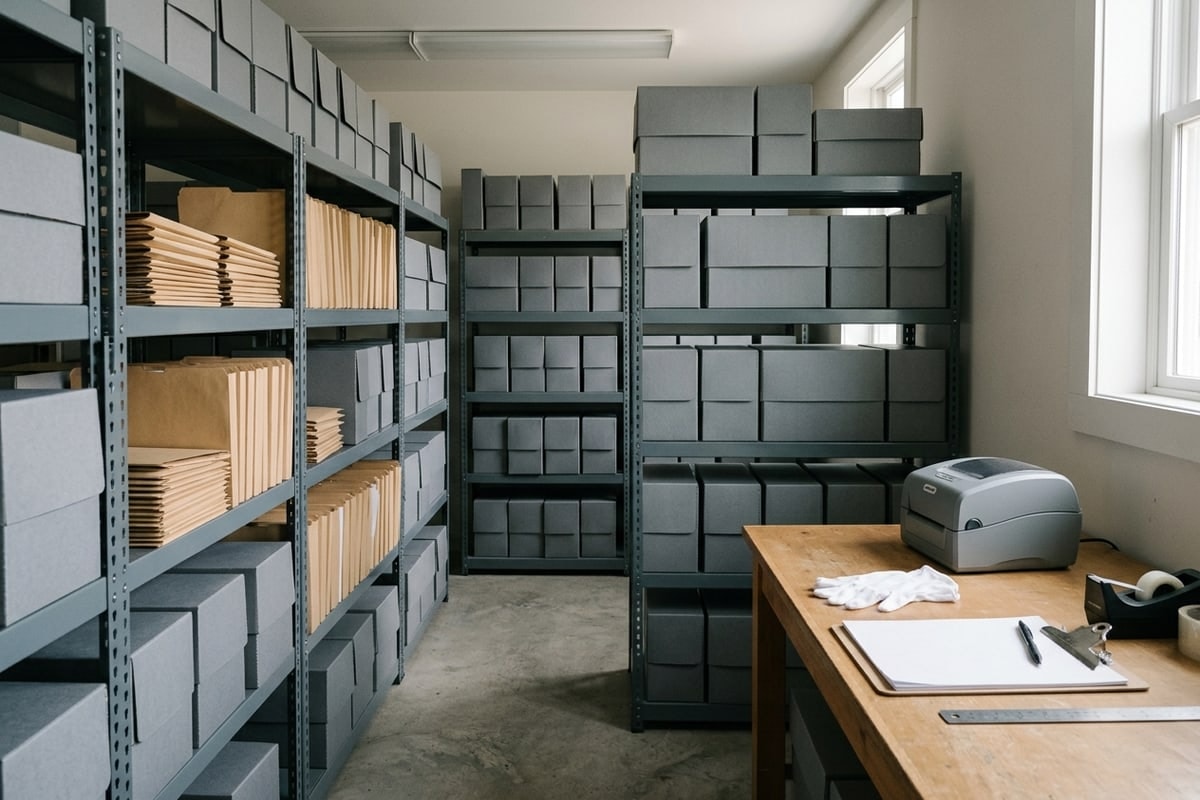
Most damage to family papers is done by well-meaning storage. Heat and damp are worse than dust; attics and basements are the two worst places in a house. Ordinary sticky tape, rubber bands, paper clips, adhesive albums and lamination all cause irreversible harm. Photographs and documents should be stored flat, in acid-free enclosures, somewhere with stable temperature and humidity. The National Archives publishes plain-language preservation guidance covering all of this, and following it costs very little.
Digitise, then deposit
A scan is a copy, not a preservation strategy — hard drives fail and formats rot — but scanning does two valuable things: it lets material be used without being handled, and it means a fire does not end the story. The more consequential step is the second one. Material that stays in a private house eventually disperses at an estate sale. Material placed with a county library, a university special collection or a state archive is catalogued, findable and permanent.
The single most useful act in this whole tradition's history was of exactly that kind: a researcher who had spent more than twenty years collecting material on the county's Lincoln legends placed the collection with a local institution, organised by claimed father, so that it would remain usable by anyone. That organisation of the material told later readers something the individual documents could not — that the county hosted several competing legends rather than one.
The honest caveat
None of this makes a story true. Careful recording, sound archiving and a properly catalogued collection produce excellent evidence of what people believed and when they believed it. That is a real historical finding and often a more interesting one than the question the collector set out to answer. Confusing it with evidence of the underlying event is the characteristic error of local history, and it is the error at the centre of this particular tradition.
Anyone wanting to pursue the records themselves should start with the research guide.