Abraham Lincoln, a North Carolinian? The Rutherford County Tradition
This is the page that most visitors arrive at, and it is the one that has to be got right. Below is the Rutherford County tradition set out as fully and as fairly as it can be — followed, in each section, by what the claim actually rests on.
The narrative as it is told
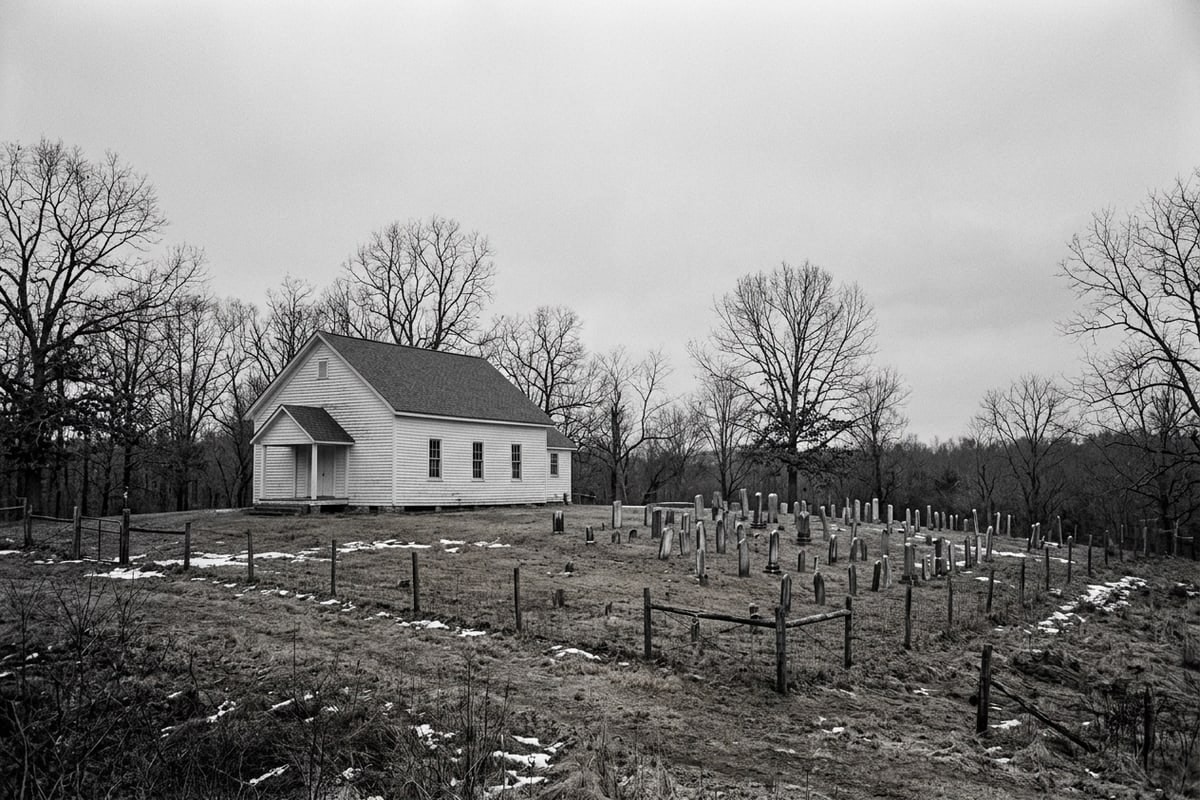
The story has been remarkably stable for a century. Nancy Hanks, orphaned or otherwise unprovided for, was bound out — placed under an indenture of the kind that was ordinary for poor children in the early republic — into the household of Abraham Enloe, sometimes spelled Enlow, a landholder whose farm lay above Puzzle Creek in what is now Rutherford County, North Carolina. In the telling, she became pregnant by Enloe; she bore a son in or about 1805 in a cabin on the hill; she was a member of Concord Baptist Church near the present town of Bostic both before and after the birth; and she was eventually sent away, leaving the county in a wagon train with the child in her lap. In Kentucky she married Thomas Lincoln, and the boy grew up under his stepfather's surname.
Two supporting details recur. The first is that the Enloe family later moved west to Oconaluftee, near Cherokee, which supplies a second and rival claimed birthplace in the mountains and explains why the tradition has two geographic centres. The second is that the minister Jesse Head, who married Thomas Lincoln and Nancy Hanks in Kentucky, is said in some versions to have noted a young child present at the ceremony.

Where the story comes from
The tradition is, at bottom, oral. Its earliest layer is not a document but a set of family recollections collected in the county in the second half of the nineteenth century and written down considerably later. That is not in itself disqualifying — a great deal of legitimate local history begins the same way — but it does mean that the story cannot be traced to a fixed point of origin. There is no letter, deposition, church minute, court record or bond that anyone has produced from the period in which the events are said to have happened.
What gave the local recollections national reach was something separate. Lincoln's law partner and first serious biographer, William H. Herndon, gathered interviews after Lincoln's death that touched on questions of parentage and of Nancy Hanks's own illegitimacy. Herndon did not advance the Rutherford County account; but once the general question of Lincoln's paternity was in print, a local story that answered it acquired a respectability it had not previously had, and the two strands became difficult to separate in the retelling.
The written sources, 1899 to the present
Five works carry most of the tradition's weight, and they are set out in full on the annotated bibliography. In outline:
- James H. Cathey, The Genesis of Lincoln (1899). The founding text. Cathey collected mountain testimony, principally around the Oconaluftee branch of the story, and shaped it into a continuous narrative. Almost everything later writers use descends from him.
- James Caswell Coggins, Abraham Lincoln: A North Carolinian, with Proof (1926). The most emphatic statement of the case, and the source of the tradition's habitual language about proof.
- James Caswell Coggins, The Eugenics of President Lincoln (1940). Listed here because it is part of the record, and flagged because of what it is: an argument built on the pseudoscience of eugenics and on inherited-character reasoning that was disreputable in its own day and is worthless now. It should be read as a historical artefact, not as evidence.
- Jerry Goodnight and Richard Eller, The Tarheel Lincoln: North Carolina Origins of “Honest” Abe (2003). The most readable modern treatment, and franker than its predecessors about the folkloric character of what it describes.
- Don Norris, Abraham Enloe of Western North Carolina (2008). A genealogical treatment of the Enloe family which traces Abraham Enloe's documented life independently of the Lincoln question.
The two documents most often produced
Beyond the books, advocates of the tradition repeatedly cite two items, and both deserve to be handled carefully.
The first is a Civil War letter published in Jean Tisdale's Dear Companion (1997), a compilation of her ancestors' correspondence. In it a wife writing to her husband during the siege of Richmond in 1864 passes on local talk that “Old Abe” was born in the county, and reports a neighbour's claim to have seen Nancy Hanks and her baby in a wagon train going west. This is a genuine period document, and it is the best single piece of evidence the tradition has — but note precisely what it establishes. It shows that the story was already circulating in Rutherford County by 1864. It does not show that the story is true, and a rumour first attested fifty-nine years after the alleged event is not corroboration of it.
The second is The Child That Toileth Not (1912) by Thomas Robinson Dawley Jr., a special agent of the federal Bureau of Labor whose research into southern mill labour brought him into the same communities. Dawley reported the Nancy Hanks story as he heard it locally. Again, this is evidence of circulation, not of fact, and Dawley's book was written to argue a case about child labour rather than about Lincoln.
What the tradition does not have
It is worth being explicit about the shape of the gap. The Rutherford County account has no birth record, no baptismal entry, no indenture naming Nancy Hanks in an Enloe household, no court or church action arising from the alleged pregnancy, no contemporaneous correspondence, and no statement by Lincoln or by anyone who knew him in Kentucky or Indiana placing his birth in North Carolina. It also has to explain away a documented Kentucky birth in 1809, since the tradition's own chronology puts the birth around 1805. Those problems are taken up in detail on weighing the evidence.
None of this makes the tradition uninteresting or its keepers foolish. It makes it folklore — a real subject, with real sources and a real history. Readers who want the standard biography as historians have established it will find it summarised in the early life and career of Abraham Lincoln, and the primary material in the Abraham Lincoln Papers at the Library of Congress.